Speed, physicality and teamwork are the cornerstones of a strong defence. All defenders in box use a short stick. There are no 6 foot long defensive sticks as seen in field lacrosse. In settled play, the defence consists of a goalkeeper and five defenders (runners).
- “Cross Check and Contain”
- Defending the Strong Side and Weak Side
- Anchors
- Badger
- The Wall
- Man Down Defence (one in the box)
- 2-Man Down Defence (two in the box)
- Defending a 2v1 Fast Break
- Don’t get picked or sealed
- Learn more…
“Cross Check and Contain”
For most of a game, a defender won’t have possession of the ball. The fundamental job of a defender is to cross-check and contain. This is to prevent or hinder any attacking players, with or without the ball, to dictate the play.
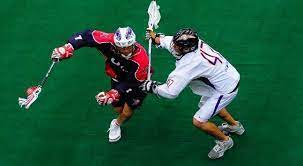
A defender has their hands on the full width of the stick, with the stick horizontal in front of them, ready to make contact with an opponent. Cross-checking (without excessive force) is the primary defensive technique for box lacrosse.
This defensive position makes you as wide as possible so you can force the attacker away from goal. When a ball carrier tries to dodge around you, cross-check his body. Make sure contact is between the shoulders and hips. Try to check with a slight downward motion, e.g. arm to hip, opposed to an upward motion. The latter may start with legal contact on the arm, but could slip up and make contact with the neck or helmet, which will incur a penalty. Any dangerous contact with a player’s head will be called a major 5-minute penalty.
A defence only needs to contain the attack and hinder their ability of get into a good scoring position. There is a 30 second shot clock, which when expired, results in a turnover. There is no need to go chasing the attackers stick and try to stick-check the ball loose. Once you have good body position to contain the ball carrier and dictate his movement, you can put pressure on his gloves to hinder his ability to make a pass.
A simple rule on defence is;
If your opponent (“your check”) has the ball, cross check him.
If your opponent (“your check”) does not have the ball, cross check him.
A simple rule of defence
Defending the Strong Side and Weak Side
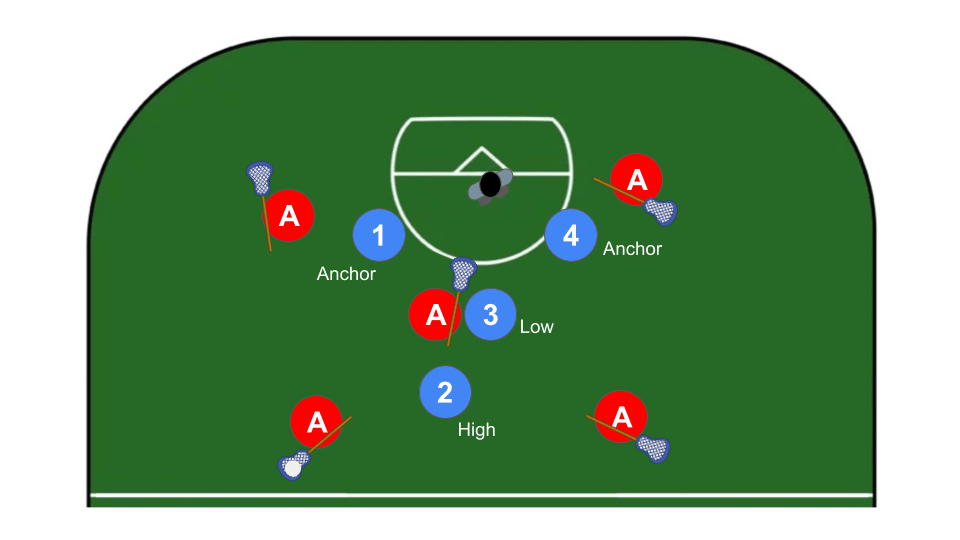
The traditional and easiest defensive system to master is to split the defence in half and align with the split in the offence. Most teams will play the five attackers with three on one side and two on the other. The side with three is the “strong side“. The side with two is the “weak side“. Each side will have an “anchor” and a “badger“, see below for more in on these roles.
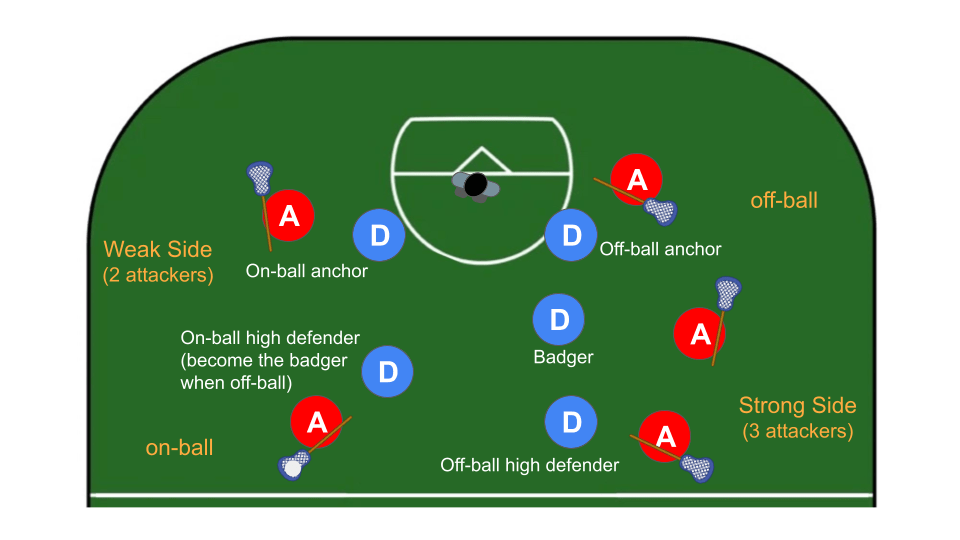
The attack will be trying to make you “switch” – swap which attacker you are checking. Every time two defenders switch, it is an opportunity for confusion or a delayed reaction by a defender. First try and avoid the need to switch by avoiding getting picked/bumped and by quick feet movement. It is the off-ball defender who has the responsibility to call “switch”. If you hear “switch”, trust your teammate and immediately find the free attacker, who is most probably heading towards your goal, wide open.
It is common practice to play a zone-like defence on both the strong and weak side. As offensive players move, they are passed from defender to defender. The three defenders on the strong side act as a “Wall“, see below.
When an off-ball attacker cuts (runs) onto the crease the defender must first try to stop the movement from happening at all. Cross-check the attacker and get in his way. In field lacrosse this would be a foul for interference, but not in box lacrosse. If the attacker does get through your check then you must stay with him and be all over his gloves so there is no way he is catching the ball. If an attacker gets one step ahead of you, that’s enough to receive the ball and shoot.
Anchors
The two lowest defenders, nearest the goal are known as anchors. Just like a boat anchor, they should not move too much. If they are pulled out of position, someone must fill their spot.
Anchors can see the play ahead of them. They should always be talking and calling picks. The highest percentage shots are from close range, around the goal, where the anchors will be. Anchors should generally play a zone defence, protecting the area no more than 2 metres from the goal crease. When an attacker moves to a low position either side of the goal, on or near the goal line extended, the primary job of the anchor is to stop that player receiving the ball.
In this clip, the red Buffalo anchor in closest to the goal takes a couple of steps up the floor, following the attacker he is checking. The ball carrier (nearest the camera) see this and takes the opportunity to beat his defender underneath to get inside and score. His teammate expected the anchor to be there to help. If the defender who was beaten knew the anchor was vacant, he would have positioned himself lower to force the attacker to go top-side.
In this clip, the blue Toronto anchor at the top of the frame is caught in two minds. His teammate is beaten and the San Diego Seals attacker is now heading towards the goal. However his check has slipped to the backside of the crease. He ends up defending neither player and the attacker on the crease receives a pass for an easy goal. In this scenario he should have trusted his goalie to make the narrow angle shot and stayed with his check.
Badger
The badger is the defensive player on the off-ball side who has one eye towards the on-ball side and is ready to jump across to help when required.
When the weak-side is on-ball, the badger will be the middle defender on the strong side. When the strong side is on-ball, the badger will be the higher defender on the weak side.
The badger needs to take a couple of steps towards the middle of the floor and open up their hips so they can see both sides of play. Their priority is always their check (the attacker on their side).
The Wall
When the ball is on the strong-side, the three defenders form a “Wall“. The primary objective of the wall is to prevent the ball carrier from going over the top or underneath.
The three defenders play a kind-of zone defence. As the ball moves between the three offensive players, the defence will pass their check responsibility up and down the wall and avoid crossing over. For example, the low/anchor defender tries to stay as the anchor and not switch positions with the middle defender. It’s not a strict zone defence as fundamentally everyone is still playing man-to-man.
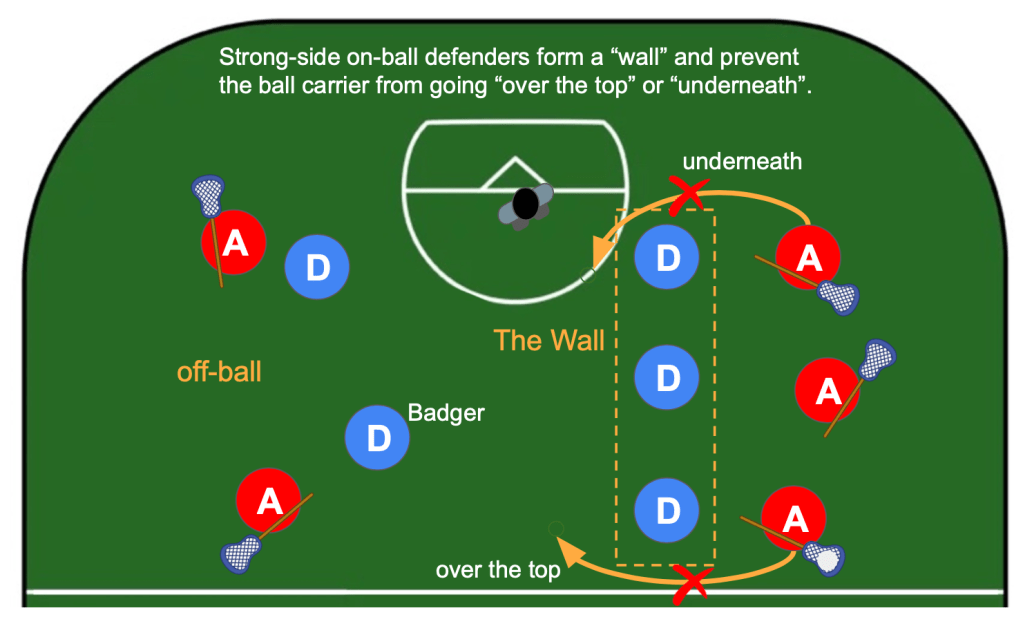
When the ball is on the weak-side, the three defenders who are now off-ball still play a wall but the middle defender also now has badger responsibilities.
If an offensive player on the strong-side moves into the middle, with or without the ball, the wall is broken and everyone plays man-on-man defence.
When playing a wall system, you can apply pressure to the ball carrier but the high defender must retain over the top responsibility and the anchor must retain underneath responsibility. To help do this, the high defender has his hips slightly rotated down the floor to stop the offence going “over the top”. The low/anchor defender has his hips slightly rotated up the floor, stopping the offence going “underneath”.
Man Down Defence (one in the box)
The primary objective of the man-down defence (5 attackers vs 4 defenders) is to deny the cross crease pass and limit the attack to either a low percentage shot from an acute angle, or a long range shot from a high position, which your goalie should hopefully save.
The cross crease pass is the most dangerous in box lacrosse as it forces the goalie to move between Zones 1 and 3 (see our Learn – Goalkeeping page). An accurate cross crease pass and quick shot release will always be quicker than the goalie moving from one post to the other.
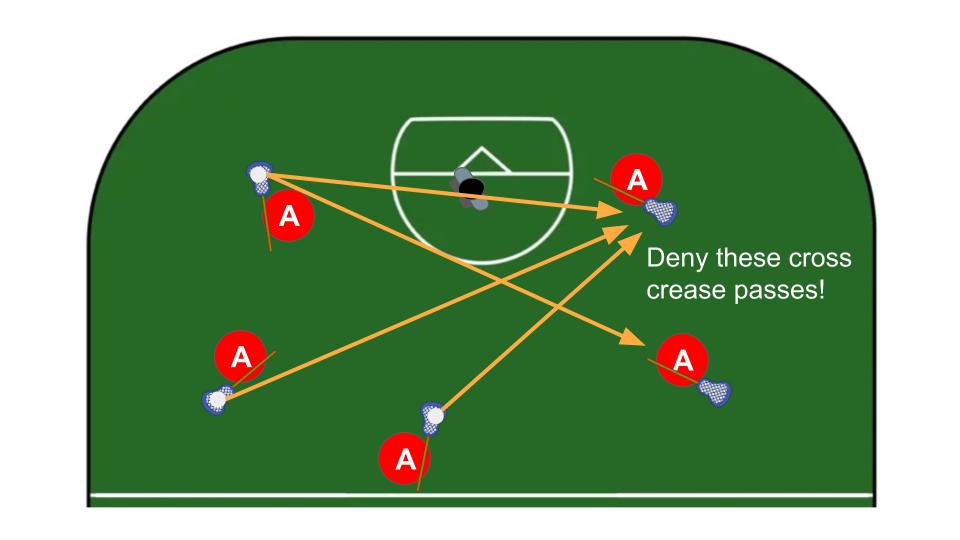
The four defenders typically play as a box; two high and two low. In the diagram below, defenders 1 and 4 are “low”, covering two attackers. Defenders 2 and 3 are “high”, covering three attackers.
When the ball is with a low attacker, defender 1 is positioned half a step higher. The attacker can happily try to shoot from this acute angle, but don’t let them beat you underneath. The opposite low defender, the off-ball anchor, has only one job in the man-down defence and that is to stop his attacker catching a cross crease pass. You give the ball carrier two options; 1) Shoot with no angle, 2) Pass the ball up.
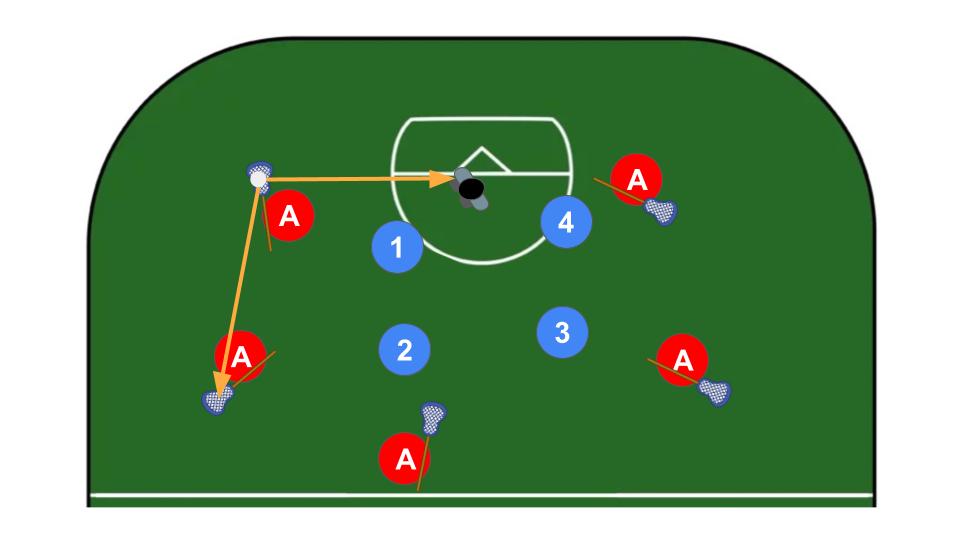
When the ball goes to an attacker with a better shooting angle, the nearest defender must take a step out, stick up, and get into the shooting lane. In the diagram below, defender 4 must resist sagging into the middle, as would be expected in a field lacrosse zone defence. If defender 4 is not within checking distance from the far side low attacker, that player will get the ball, release a quick shot and most probably score. You give the ball carrier two options; 1) Pass down, 2) Pass right.
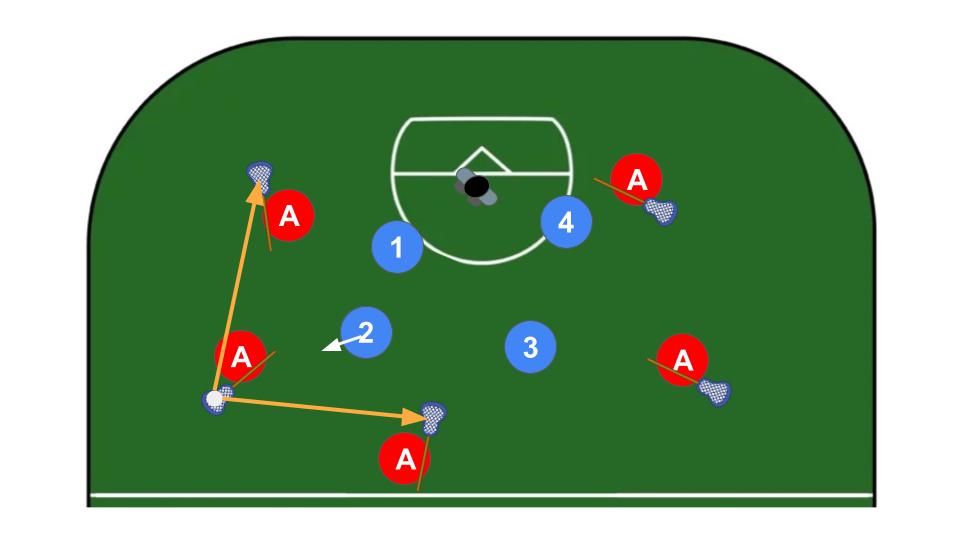
When the ball is top-centre, this gives the best shooting angle, so defender 2 must get in the shooting lane. The shooting lane is the line between the attackers stick head (not the attackers body) and the far post of the goal. You give the ball carrier two options; 1) Pass left, 2) Pass right.
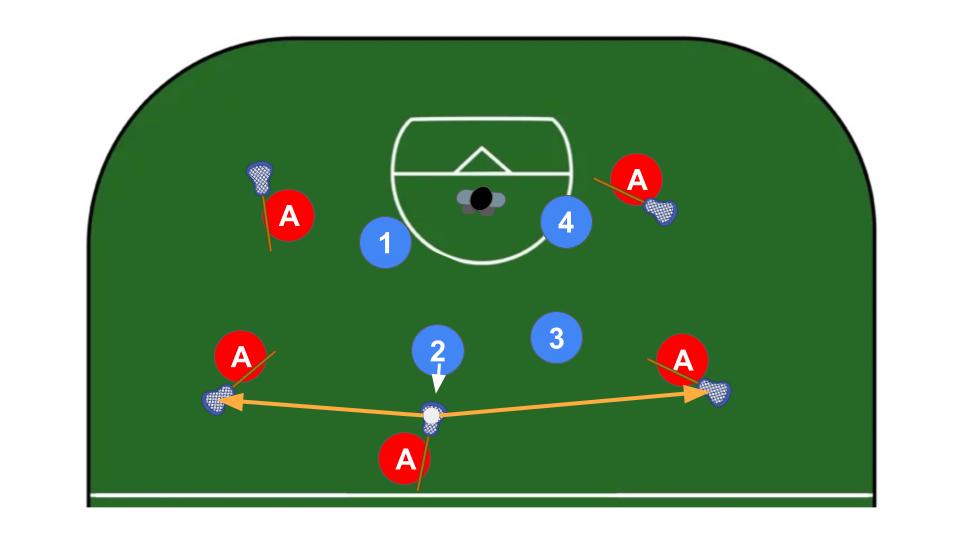
As the ball moves across the attack, the four defenders normally don’t need to rotate, as they typically would within a field lacrosse zone defence. The two low defenders stay low. It is the responsibility of the two high defenders to move between the three high attackers. You give the ball carrier two options; 1) Pass left, 2) Pass down.
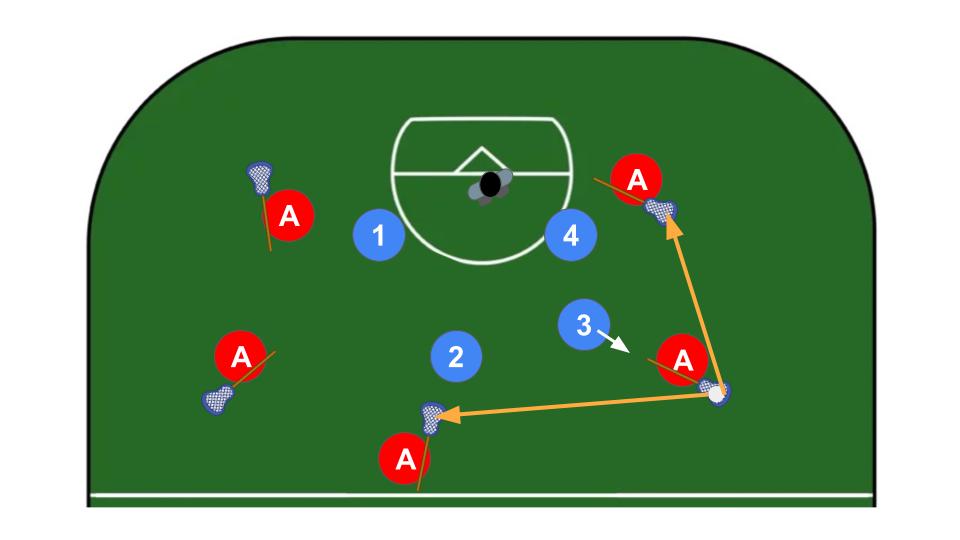
An experienced attack who realise the defence is not giving up and easy shot will likely move an attacker into the middle. This creates a different challenge for the man-down defence.
An attacker inside can set picks and seals, allowing a team mate to run onto the crease, with or without the ball. The middle attacker can also receive a pass. In the diagram below, defender 3 has to take responsibility to be aware of what the attacker in the middle is doing. Defender 3 must be ready to jump across if the middle attacker has set a pick or seal, or jump across if the attacker is going to receive a pass.
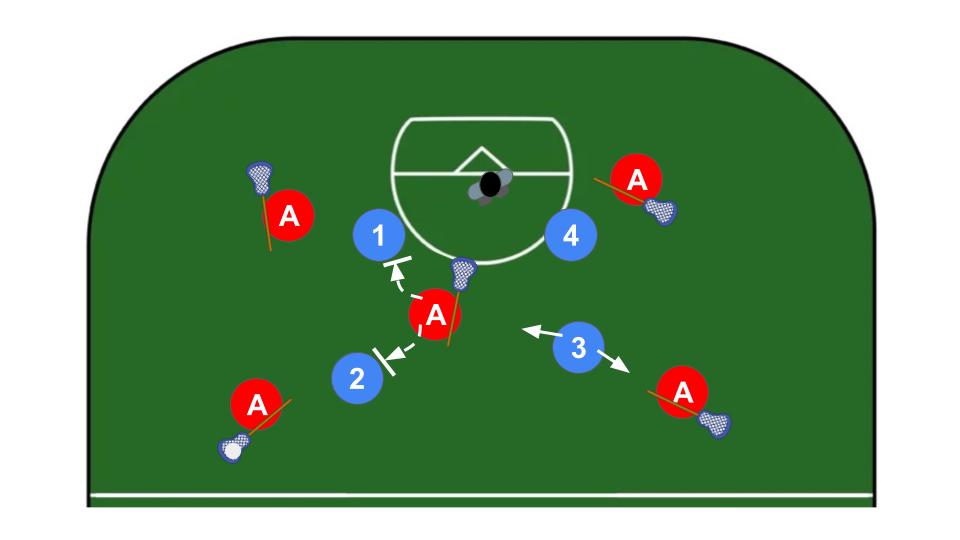
For the avoidance of doubt, when the attack place a man in the middle, the anchor defenders must stay with their low attackers and not creep into the middle to offer help.
If the man-up attacking team are getting busy on the crease, settings screens or picks, then the two high defenders can switch from being left & right to high & low. The low defender deals with any players on the crease. The high defender deals with any players in a high position.
2-Man Down Defence (two in the box)
The minimum number of defenders allowed is three. This will occur if two players are serving a penalty. If a 3rd penalty occurs, this will result in a penalty shot.
Defending with three players against five is challenging. The priority is to prevent the cross-crease pass, just as with the single man-down defence.
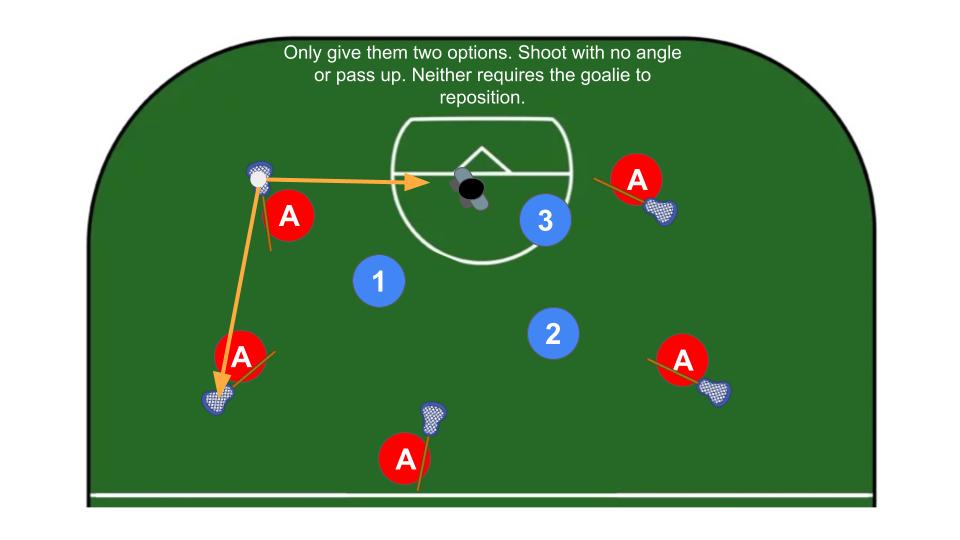
Three defenders play in a triangle. When the ball is in Zone 1 or 3, the player with the ball is not covered. This may sound like madness but there is limited angle to shoot and your goalie is set, protecting the majority of the goal. The defenders protect the passing lanes to the attackers on the opposite side of the floor. You give the ball carrier two options; 1) Shoot with no angle, 2) Pass the ball up.
When the ball is in Zone 2, a defender covers that player and stands in the shooting lane. The shooting lane is aligned with the attackers stick, not their body. The two other defenders are protecting the passing lanes to the attackers on the other side of the floor. You give the ball carrier two options; 1) Pass down, 2) Pass across.
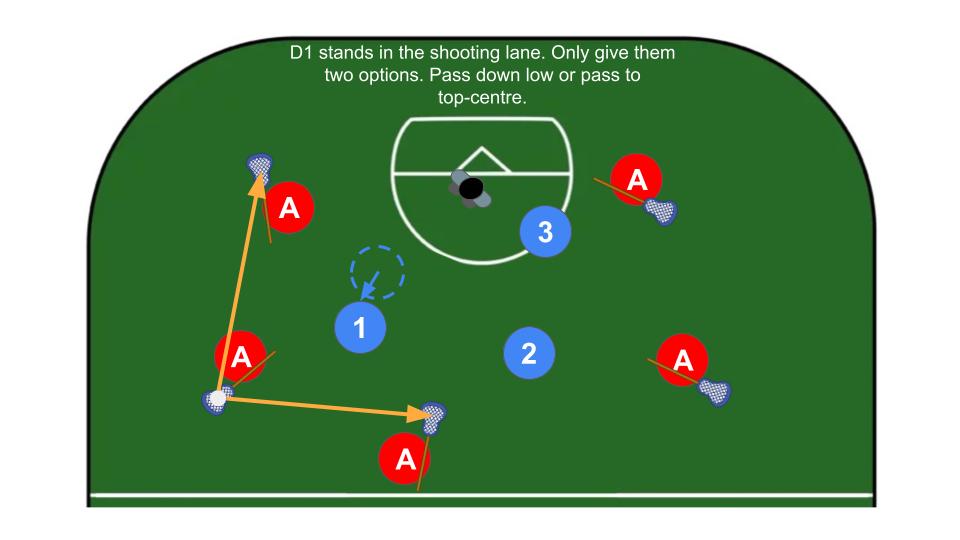
Just like in field man-down zone defence, as the ball moves around in one direction (here, anti-clockwise), the defence rotate in the other direction (here, clockwise). The D2 defender comes across to get into the shooting lane. D1 drops low to join D3 preventing the pass to either low attacker. You give the ball carrier two options; 1) Pass left, or 2) Pass right.
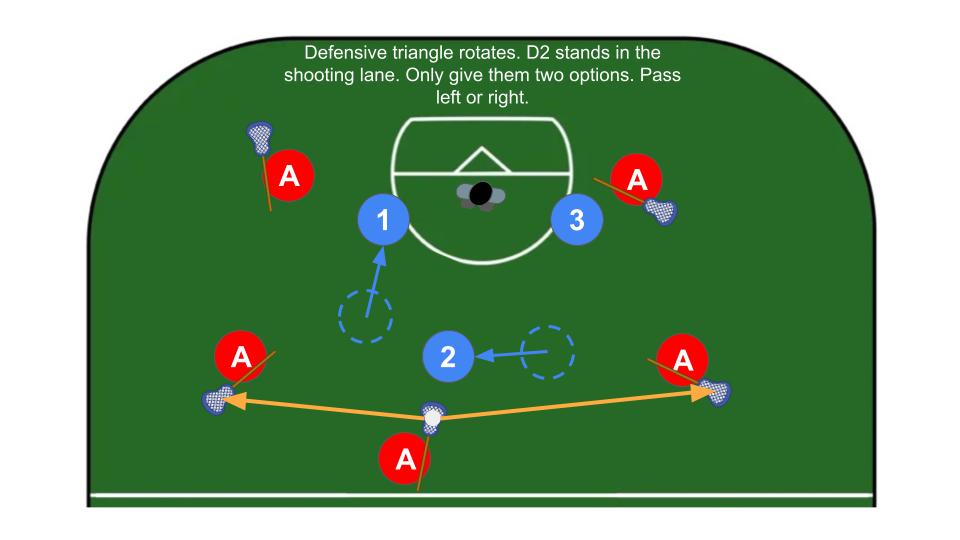
If the ball continues to move anti-clockwise, D3 rotates up to get into the shooting lane, leaving the low attacker free. That’s OK. If the ball is passed to that low attacker, our goalie is set protecting the near post. D1 must resist sliding across (which you would in field lacrosse). D1 must stay covering the low attacker on the other side of the floor. You give the ball carrier two options; 1) Pass down, or 2) Pass across.
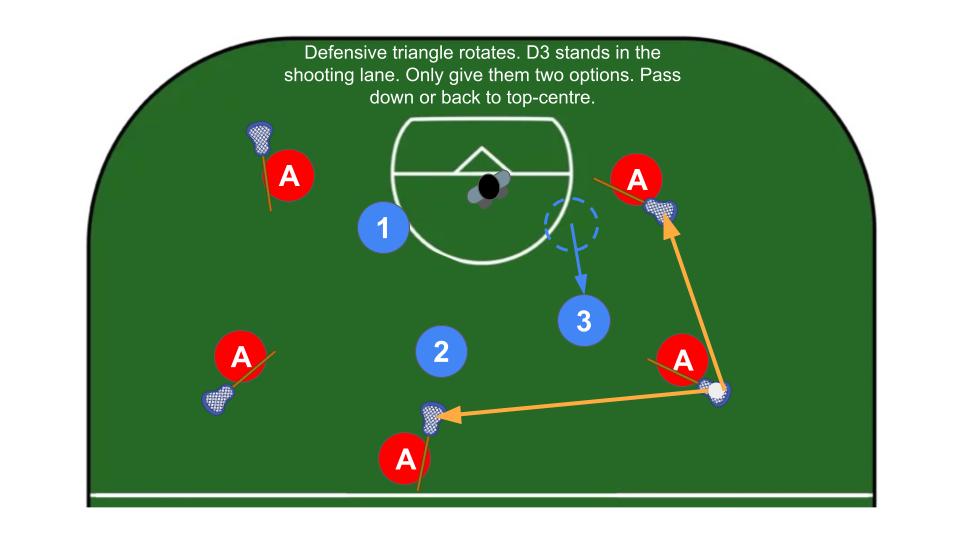
The attack playing 5v3 will almost always keep everyone on the outside and develop a shooting chance. If an attacker moves inside and ties up a defender you could be facing 4v2 on the outside. If an attacker slips behind the goal, they will look to get the ball to him for the dunk shot.
Watch this clip for textbook 3-man defence by the Toronto Rock. Note how San Diego have kept one attacker back behind the line. They are essentially playing 4v3 with that attacker as the bat-stop to prevent any rebounded shots going ‘over and back’.
Defending a 2v1 Fast Break
The ball is turned over in your offence. A quick bench change gets one defender and one attacker on the floor, with the ball carrier running down the floor, giving a 2 v 1 fast break.
Defending this situation may appear counter-intuitive but as the single defender you MUST NOT slide across to the ball carrier. If you slide across, you leave the single attacker open, who can receive a simple cross-crease pass. Such a pass forces your goalie to move from post-to-post, which makes it easy for the attacker to score.
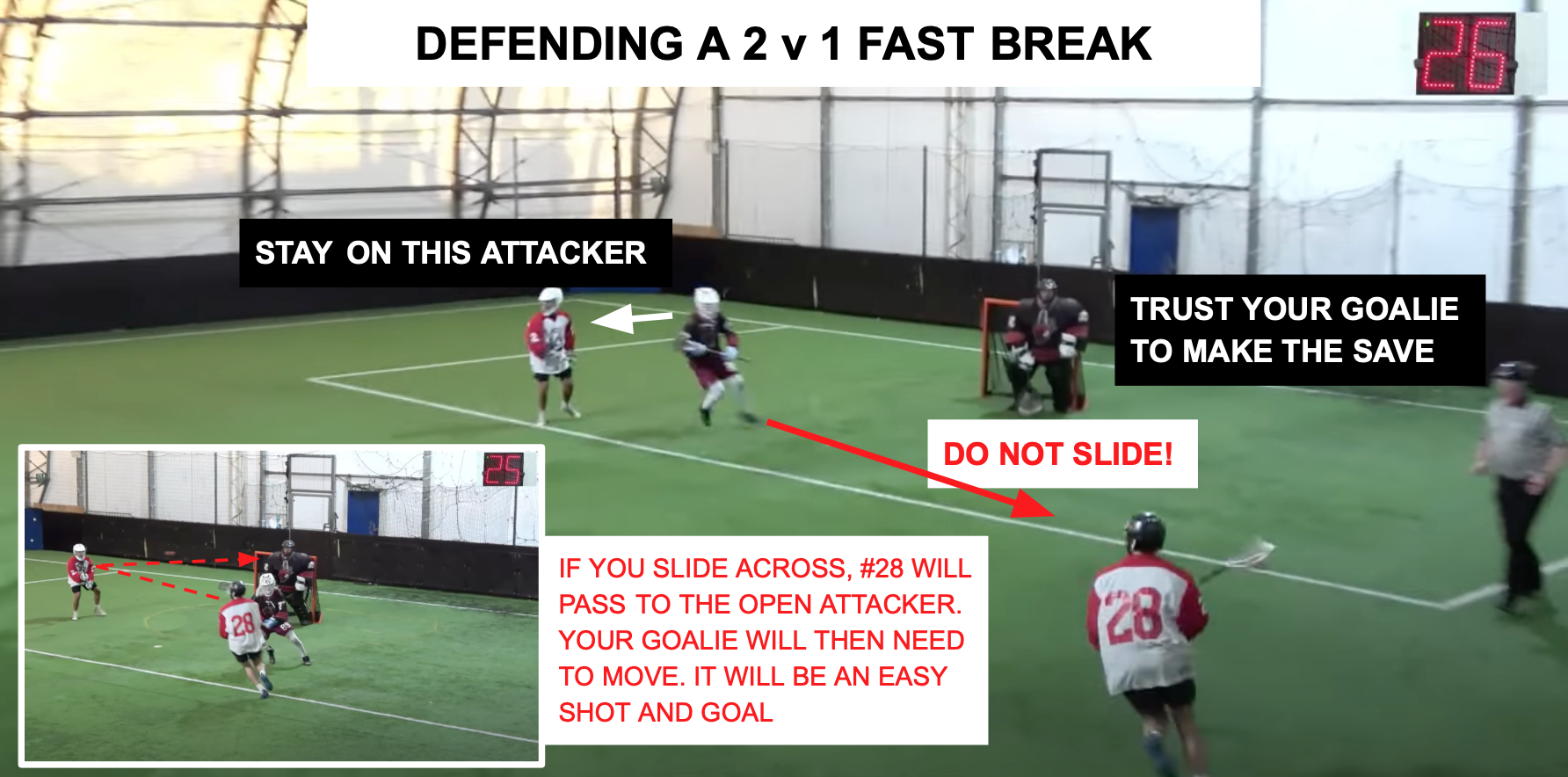
The ball carrier running down the floor on the fast break will be a defender or transition player. Force that player to shoot, with your goalie set and ready. Hold your position for as long as possible and deny the pass to the attacker. There is a much better chance the defender will miss the goal or your goalie will make the save, compared to a specialist attacker scoring from the cross-crease pass.
Don’t get picked or sealed
A good offence will try to “pick” or “seal” a defender. A “pick” is when an offensive player, without the ball, gives you a push, often from behind, and often as a cross-check which may unbalance and allow the offensive player you are defending against move into space. A “seal” is when an offensive player blocks you and prevents you going where you want to go. Technically the offensive player cannot hold you, or your stick, but often a seal will include some kind of hold, even for a split second, before a referee can see and call a penalty.
The priority for the defender is to not get picked or sealed. This can be achieved by good body position, to be able to see someone coming to try and pick or seal, and/or communication from your team mates to tell you someone is coming.
In field lacrosse a teammate may shout “pick left” meaning someone is coming to set a pick from the left. In box lacrosse because of the smaller floor area, left & right could be confusing so most teams use the term “open“. When you hear a teammate shout “open” it means a pick is coming, so you open up your body so you can see it coming and try to avoid it.
To avoid the pick or seal, a defender needs quick feet to avoid the contact but still remain aware of the offensive player they are checking. Some players like to spin to avoid a pick, others like to fight over or under the pick. It is the off-ball defender’s responsibility to decide if there should be a “switch“. As the on-ball defender unless you hear “switch“, stay with your check.
Learn more…
Box Lacrosse Breakdown has some great short tuition videos like this one that explains 10 terms every defender needs to know; 10 Switch, 9 Stay/Fight Through, 8 Help/Support & Slide, 7 Double, 6 Open, 5 Pass (in England we say “Pass/Hand Off“), 4 Roll Out, 3 Get on Hands, 2 Muck (we don’t use this term in England) and 1 Overtop and Underneath.
 England Box Lacrosse