Scoring goals, especially against a strong goalkeeper, is one of the hardest challenges of box lacrosse. A good goalie will make shots from narrow angles or shots from distance very low percentage efforts. The arena boards also mean those shots from long range, if missed, are likely to rebound back down the floor causing an ‘over and back’ turnover, or worse, result in a fast break for the opposition.
- Split the floor down the middle – strong side – weak side
- Get physical and get inside their defence
- Two Man Game Basics
- Achieve an offensive physical vs passing balance
- Move the goalie
- Manage the shot clock
Box offence requires a three-way balance of accurate ball movement, off-ball physicality and time/position awareness.
Split the floor down the middle – strong side – weak side
The first offensive fundamental is appreciating shooting angles. A right-handed player will find it much easier to score playing on the left side of the offence. Their stick head will be to their right, every step taken to the right, opens up more shooting angle. Right-handed players play on the left side (when looking down the floor). Left-handed players play on the right side.
Imagine a line splitting the floor down the middle, goal to goal. This splits the floor into two sides. With five attackers (runners) on the floor, the “strong side” will be that with three (3) attackers. The “weak side” will be the side with two (2) attackers. A good box offence is equally balanced with right and left-handed players.
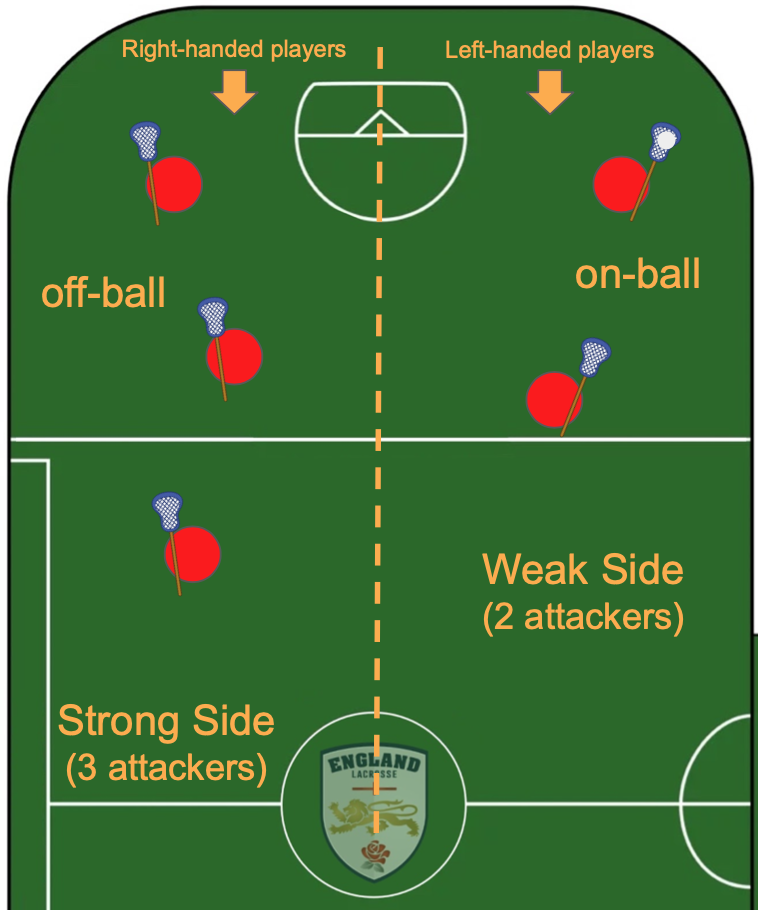
When the ball is on one side or the other, that side is “on-ball“. The opposite side is “off-ball“. Whether you are on the strong or weak side, on or off ball, a box lacrosse attacker is always busy. There is no time or room to stand still waiting to get the ball, shouting “I’m open” or “Here’s your help” to your team mates that you would in field lacrosse. If you do find yourself with space and wanting the ball, mentally count to 3. If the ball does not come, get physical and get inside their defence.
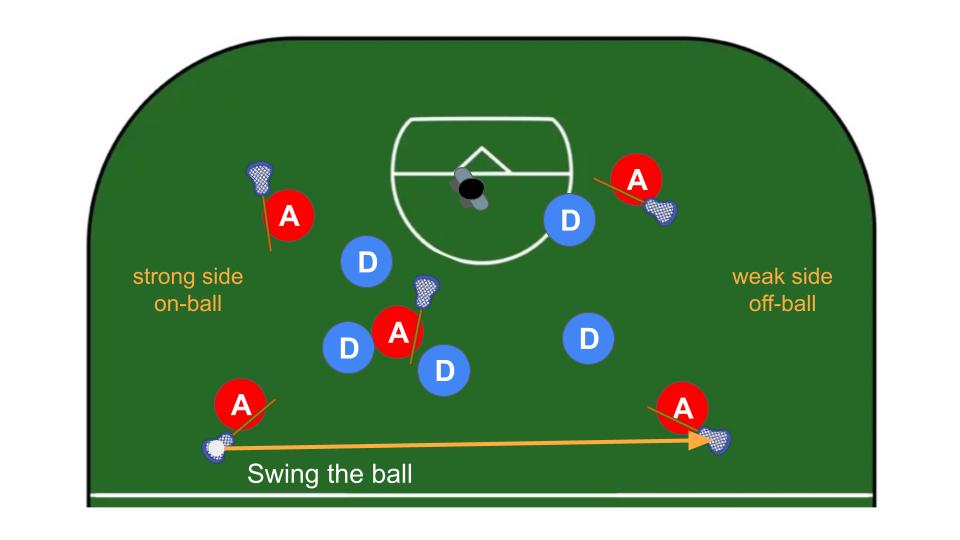
Another term you will hear all the time is “swing” the ball. This is a pass from the on-ball side to the off-ball side, almost always between the two highest players, furthest from the goal.
An attack can also swing the ball behind the goal. An attacker moving to a position behind the goal can be a good tactic as gives three options;
- Swing the ball
- Feed the crease
- Dunk shot
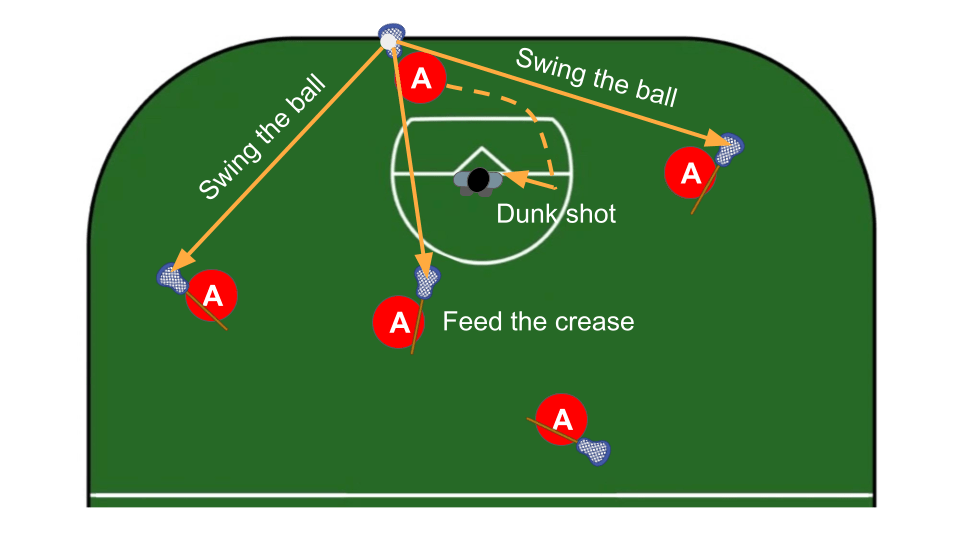
Note. When playing on a smaller floor size, there may be limited space behind the goal. Be wary of the goalkeeper being able to intercept a pass to a player behind the goal.
Get physical and get inside their defence
As an attacker, you will be cross-checked continually, whether with the ball or without. Be prepared to receive contact at any time, from any player, from any direction. Contact must be between the hips and shoulders. That’s why all box players have fully padded upper bodies; gloves, arms, shoulders, chest and back. Avoid having any gaps between your pads as a cross-check will find that soft spot and it will hurt. Cross-checks where you have padding only hurt if you are not prepared to receive the contact.
However, unlike field lacrosse where attackers typically only get one over the defence through scoring, a box attacker can get physical with cross-checks, screens, seals and bumps on the defenders. Hit them, then score on them, makes for a happy offence.
The box floor is tiny compared to a full 10-a-side lacrosse field. There is no place in box lacrosse for an isolation dodge offence based on matching up your best dodger with their weakest short-stick midfielder. The reason is two-fold.
First, the defender will be cross-checking you, using the full width of their stick. This makes that defender twice as wide as a field short-stick midfielder, so much harder to dodge past.
Second, the next nearest defender will only be two or three steps away. If you do manage to dodge one defender, another is likely to be on you immediately and you’ll run directly into their cross-check.
To create space in the attack and to open up running lanes towards goal, off-ball attackers have to block/push/bump the defence.
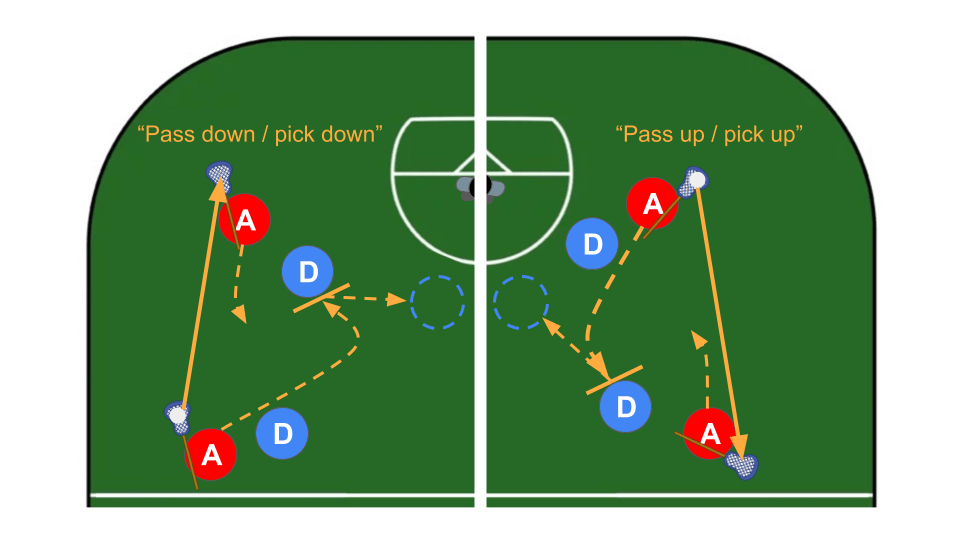
The best angle to approach any defender is from behind. It is often termed “finding the back” of the defender. Approaching from behind means they may not see you coming, so it’s more difficult for them to evade the contact. You block or “pick” the defender which allows your team mate to move into the space this creates. This is the fundamental offensive movement, known as a “pick & roll“, which is at the heart of the “two man game“.
Two Man Game Basics
Two vs two offence with a well executed “pick & roll” is the most effective ways to get inside a defence and create a high percentage shooting opportunity. The defence often have to resort to (illegally) holding an attacker to prevent them getting into the space created. If you don’t create a shooting chance, you might still draw a foul and a man-up power play.
The clip below is field 6-a-side lacrosse from the 2022 World Games. Canada in red have the ball against Japan in white. The pick & roll technique is as per box lacrosse except in field 6s, the attacker setting the pick must not make contact while moving.
In this case, a pick with contact is not needed as both Japan defenders stay with the ball carrier. It is very close to being a ‘slip pick’ (see below). This gives the Canada attacker who has ‘picked and rolled’ a clear path to goal. The still frame below shows the final pass (which for added spice was a ‘behind the back’ pass) and the Japan defender about to turn realising the danger but too late to stop Canada scoring.

Other two man game skills all start with the same starting movement, but with subtle variations to keep the defenders guessing.
Firstly, where on the floor to set-up the two-man game? It could from anywhere but the most effective position is from the half-boards; the point where the boards/dashers change from full height to half height in a hockey rink. On a field or sixes pitch, about 15-20m in front and to one side of the goal; exactly where it is set-up in the above clip from CAN v JAP sixes. From this set-up position, the two offensive players can initiate any variation of the two-man game with enough room to execute the manoeuvre, but also not too close to the goal to run out of space, and also not too far away to give enough time and space for another defender to slide across to help.
A “slip pick” is where you go to engage the defender but don’t make contact and instead “slip” towards the goal. If your defender thinks you are going to set the pick, he may bite early and switch too soon, leaving you wide open. After a couple of successful pick & rolls, try a slip pick.
A “screen” is where you engage the defender and become a screen for the goalie allowing the ball carrier to shoot around your body.
A “seal” is where you engage the defender and limit their ability to move anywhere. Typically this opens up a running lane for a team mate with or without the ball. The seal is especially useful in a man-up situation. Seal one or more defenders to leave 4-on-3, 3-on-2, 2-on-1, or if all four defenders are sealed off, the ball carrier versus the goalie. Be aware that if a seal is set for more than a couple of seconds it could then get called by a referee as a holding minor penalty.
You can take the two man game to the next level by studying the excellent short videos from Box Lacrosse Breakdown.
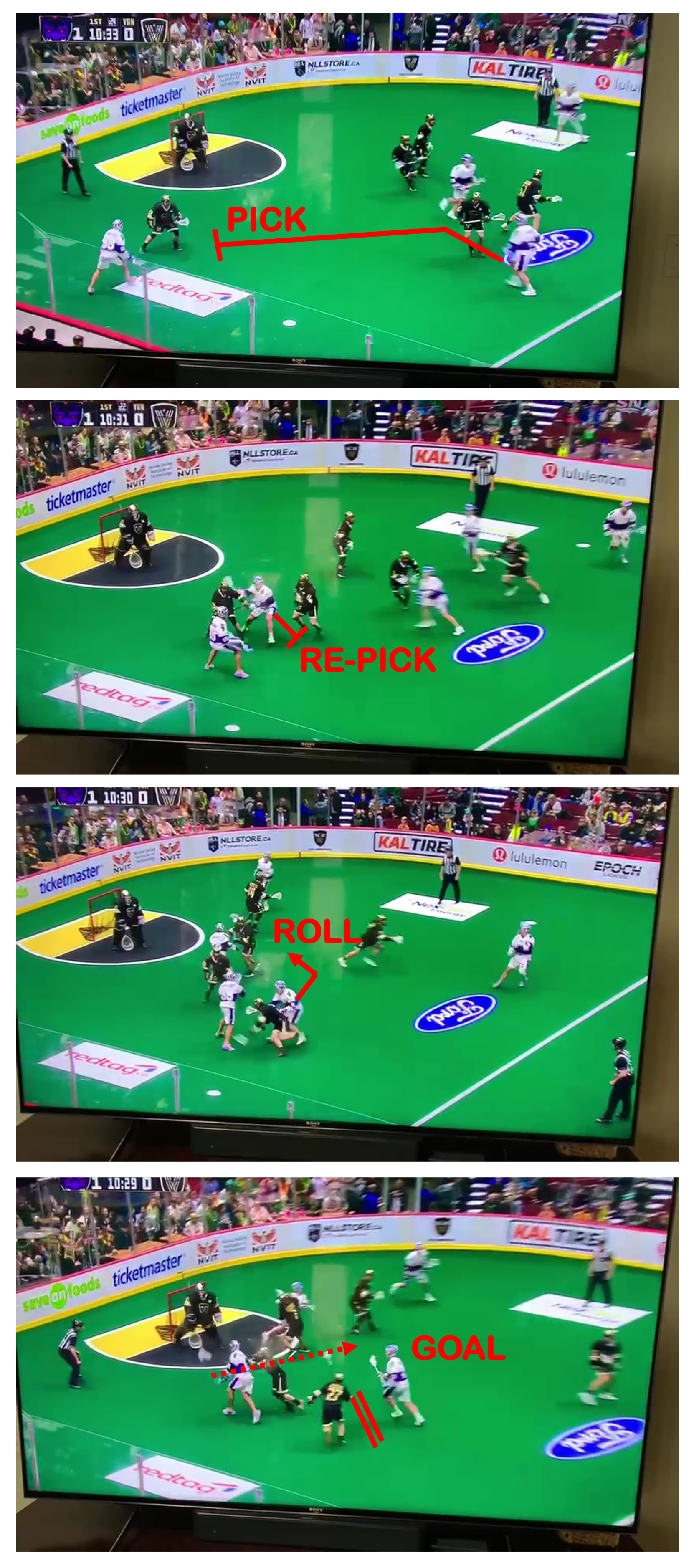
Setting a pick is not a once-only thing. If nothing instantly develops from the pick, re-pick, i.e. pick another attacker, and if still nothing develops, go pick the first attacker again. The “re-pick” shown in the below example results in a goal for Panther City in the NLL.
If we break the above play down, it starts with the ball carrier at the half boards. His team mate comes down from the top to set a pick. He then re-picks his original check (the player who was originally marking him). He then rolls towards goal, get separation due to the pick and the ball carrier finds him with an underneath shovel pass, and he scores.
Achieve an offensive physical vs passing balance
Offensive physical play must be balanced with offensive passing play. All five attackers can’t all be setting picks as someone must have possession of the ball. Conversely, if all five attackers are looking to get into space to receive a pass, they will naturally migrate to the outside of the floor, away from the defence. This may result in some controlled possession but will limit the offence to low percentage shots from outside.
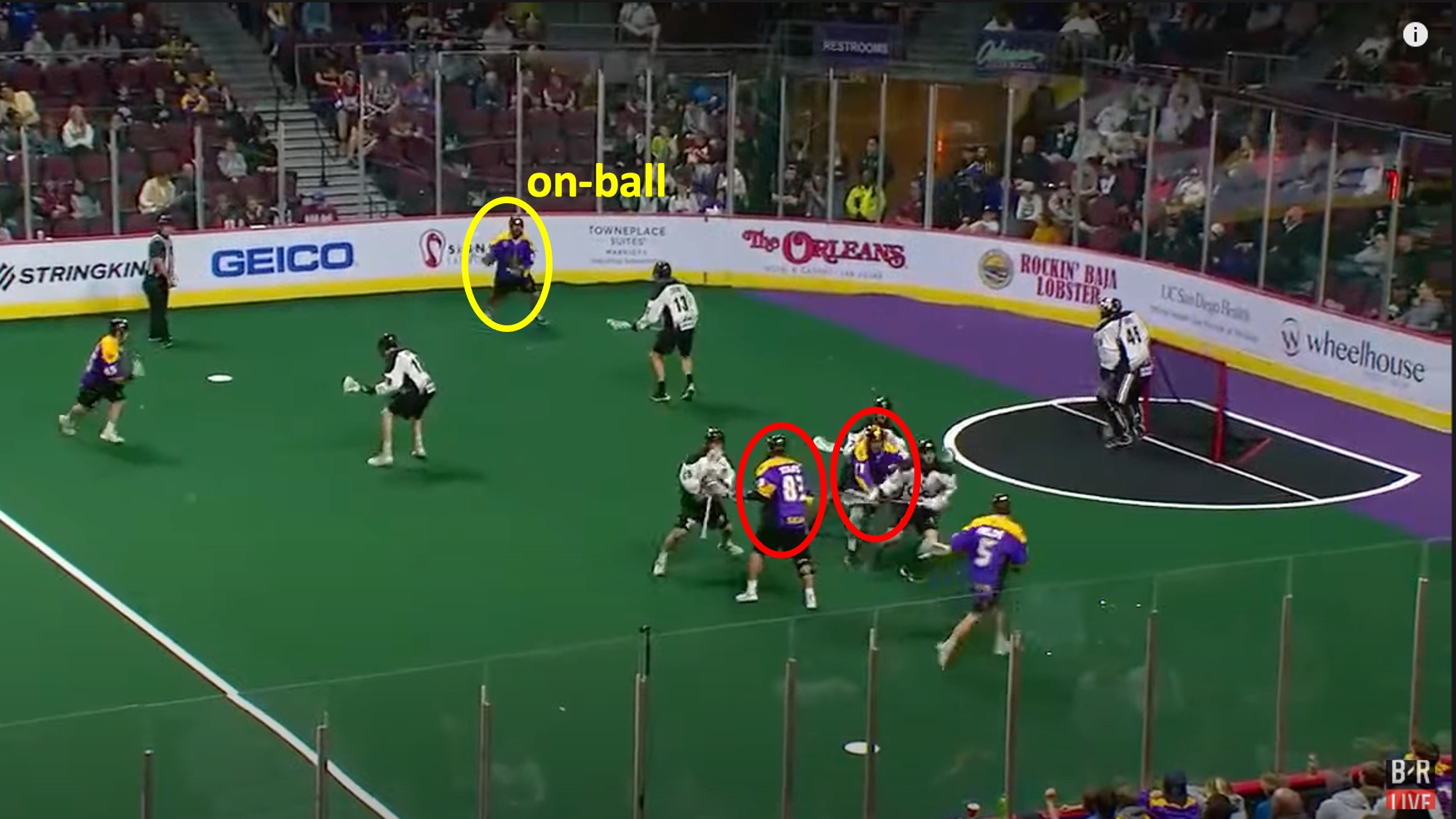
A guide to achieving good physical/passing balance is to ensure there is always one or two attackers inside the defence, getting physical. Watch any game from the NLL or top teams from the World or Euro Championships and pause the film at any time during a settled offence play. Count how many attackers are on the outside and how many are on the inside.
In this freeze frame, the San Diego Seals have two attackers on the inside engaging defenders. The inside attacker facing the camera rolls to goal, receives a pass and scores.
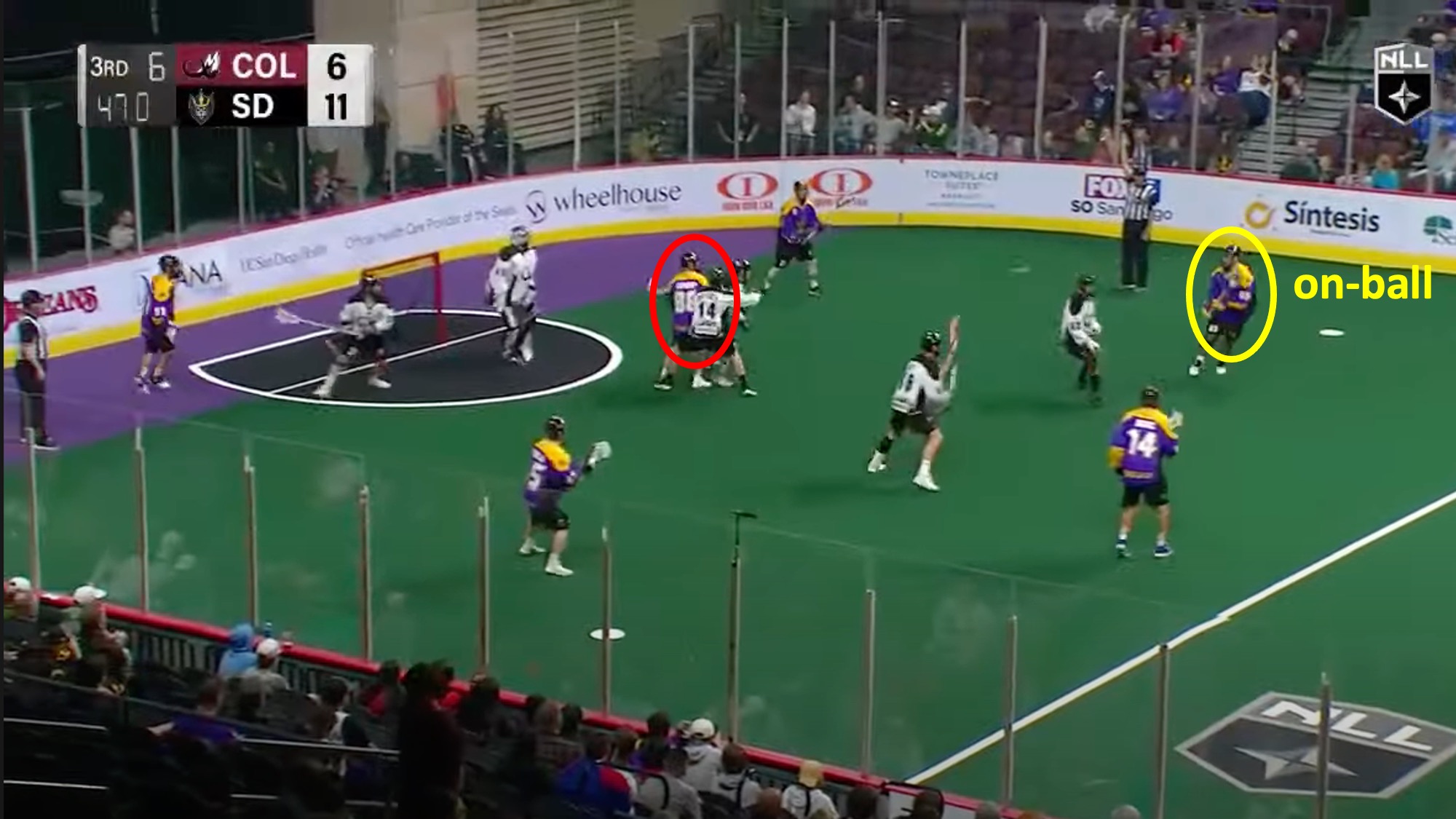
In this freeze frame, San Diego have a delayed penalty coming in their favour, have pulled their goalie, and are playing 6v5. The Seal attacker has tied up two Colorado defenders, leaving 5 v 3 on the outside. The ball is passed to #5. The attacker on the left runs behind the goal and receives a pass from #5 and finishes with a dunk shot around the far post. No defender is anywhere near him as the low defender on that side has been sealed off.
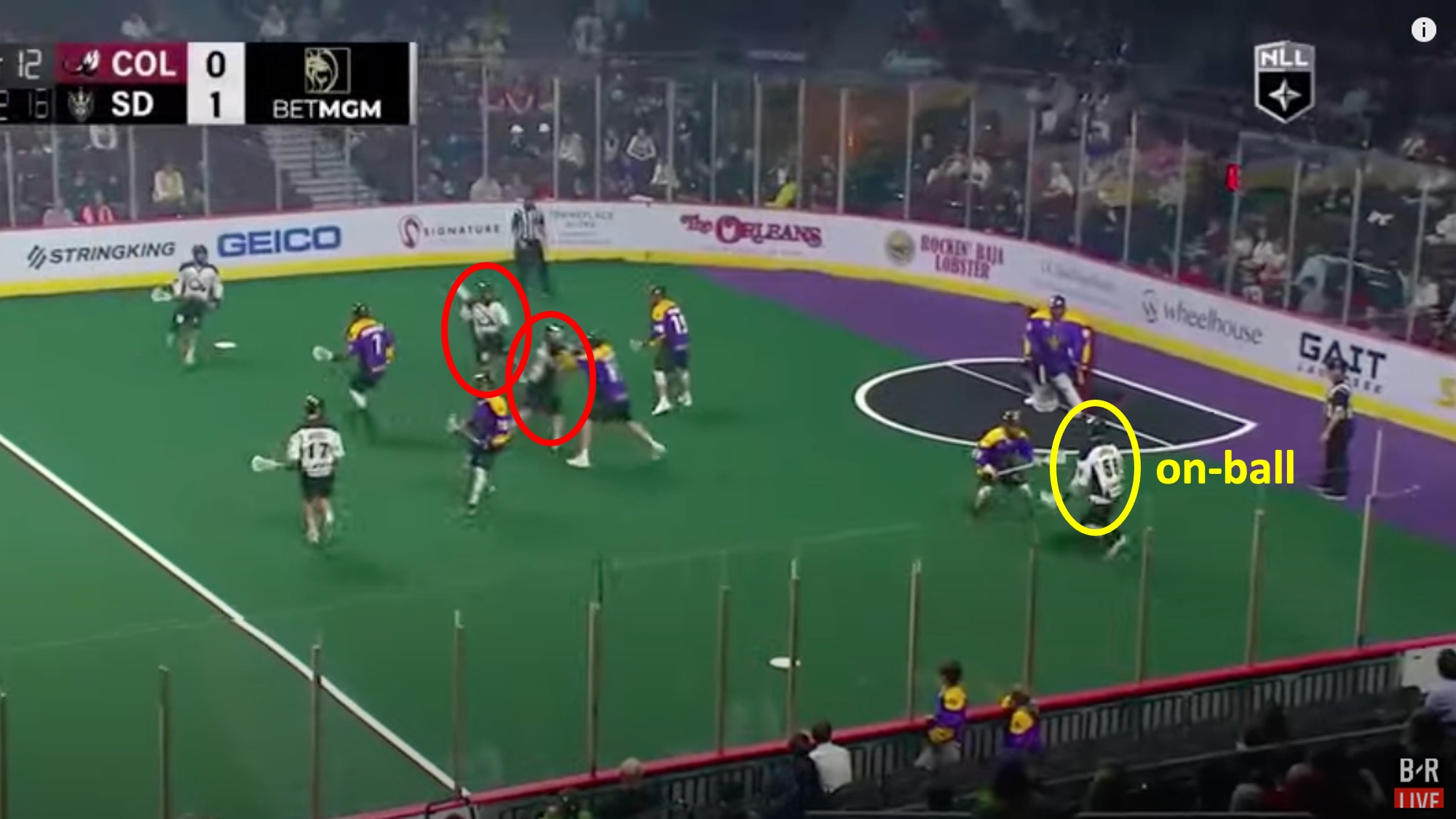
This final freeze frame sees two Colorado Mammoth attackers on the inside attracting the attention of four defenders. The ball is actually down low with the lefty attacker who is 1v1 with loads of space to dodge, drive to goal, and score. Look at where the four defenders are looking. If the other Colorado attackers were just standing around ball watching, the Seals defence would see the danger and someone (ideally the “badger”) would jump down to help. In this case, the badger is one of the defenders getting cross-checked in the middle of the floor.
Move the goalie
The highest percentage goal chances come when the attack force the goalie to move position. Read our goalie guide to understand when goalie will be set and when a goalie will move their position.
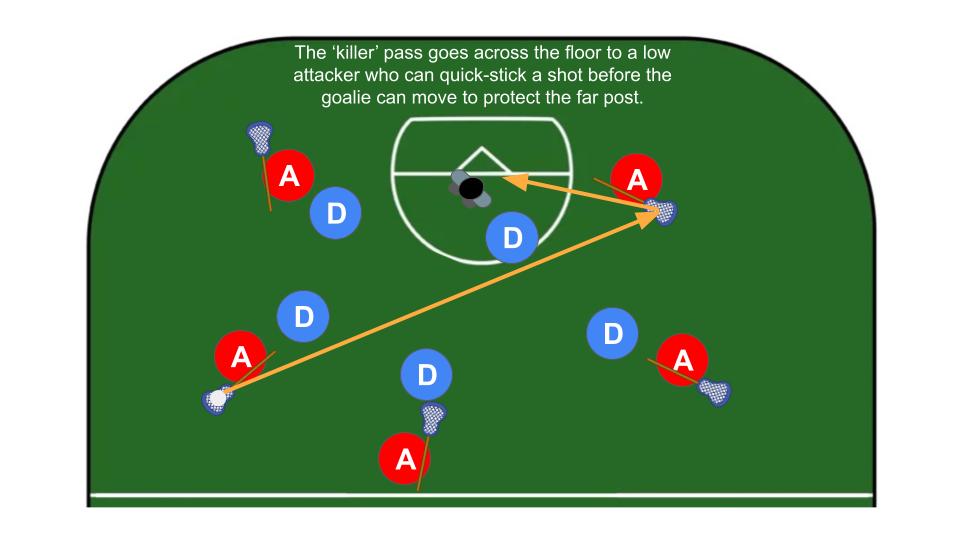
The “killer” pass is one that moves the goalie from Zone 1 to Zone 3 (of if you have not read the goalie guide, from one post to the other). The primary job of the anchor defender is to prevent this highest percentage shot. However, all too often, the anchor gets pulled out of position. On a 2v1 fast break, the single defender will let the ball carrier shoot, as the goalie is set, rather than slide early and allow a pass that will force the goalie to reposition.
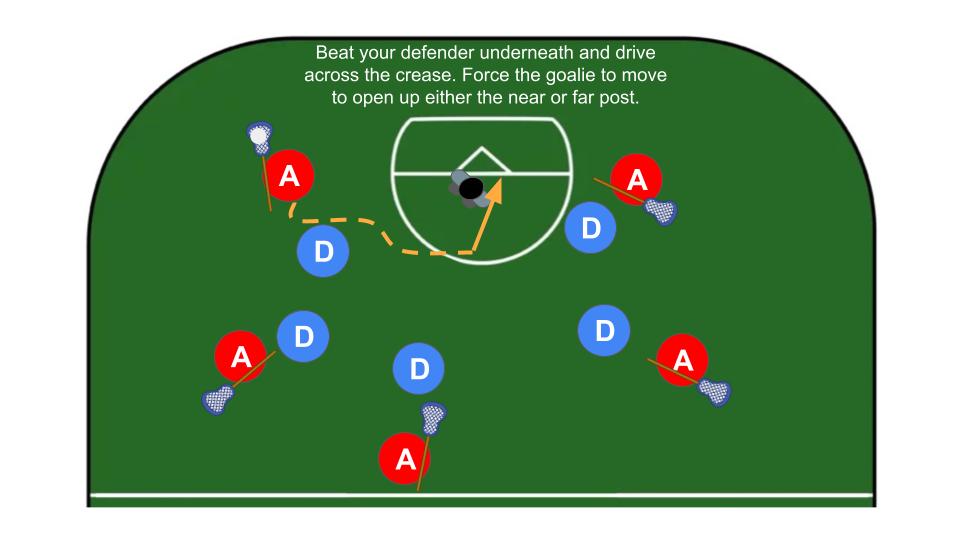
An attacker who can beat a defender underneath needs to drive across the front of the crease to force the goalie to also move across. If the goalie moves too late, the far post is open. If the goalie moves too early, the near post will be open.
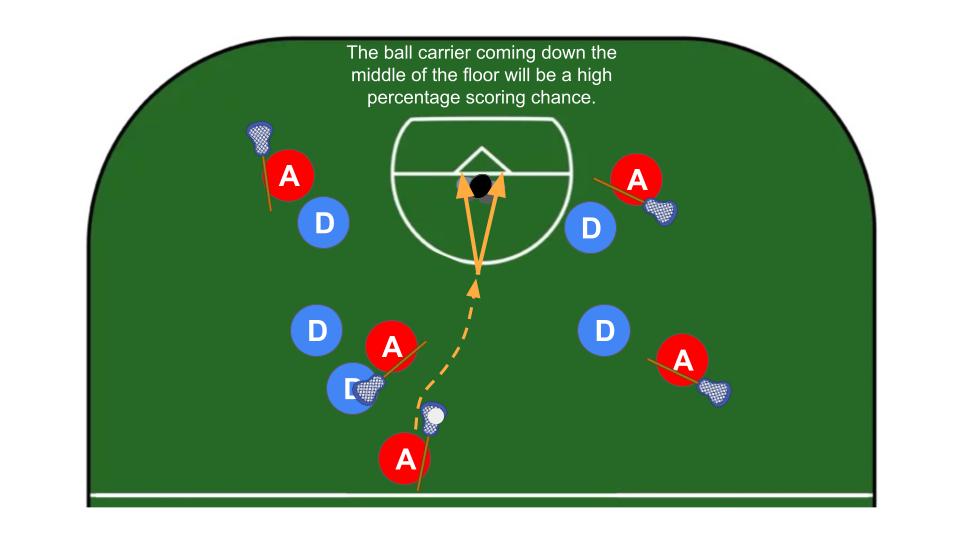
Any opportunity to drive the ball down the middle of the floor will give a high percentage shot. There is no angle helping the goalie. You can shoot to the left or right post. Pump fake to make the goalie move first. Often just the drop of a shoulder or glove will make a goalie jump.
Manage the shot clock
Awareness and management of the shot clock can make a significant impact on winning or losing. Box lacrosse is a possession game. If the opposition does not score, or get a shot clock reset, in 30 seconds, we get the ball.
A simple way to manage the shot clock is to break it down into four phases.
30-20 secs = Transition or fast break

Read our guide to transition play.
Unless a fast break is on, don’t force the pass. The last thing your team wants is a quick turnover. Your defence won’t be happy if they have to get back immediately on the floor.
As the defence come off the floor, the attack can get on. If a defender has transitioned the ball, someone goes to get it, allowing that defender to get off. Get set-up in the strong side / weak side formation depending on how many left/right handed players are on the floor.
25-15 secs = Settled possession

Once all 5 attackers are on the floor you don’t need to rush creating a shooting opportunity. Spend the middle 10 seconds moving the ball in settled possession. React to the defence. Are they applying pressure to the ball carrier? Are they sitting back and protecting the inside space?
If the defence are not applying pressure to the ball carrier, move the ball around the outside, giving everyone a feel for the ball.
If the defence are applying pressure then retaining possession will be harder. Players off-ball must get physical, get inside and find the back of the defender applying pressure, putting him off balance, allowing your teammate to run into space created.
15-5 secs = Work a high percentage shot

Now is the time to execute those practised offensive plays.
The on-ball side can work the 2-man game. If nothing develops, swing the ball to the other side. Don’t then stand still and watch. If you swing the ball, run to the crease, engaging any defender in your path. If the ball finds you, shoot. If not, turn around and find the back of a defender. Then locate the ball as it will either be coming your way via a pass, or may be coming back over to your side via another swing pass.
5 secs = Shoot at the goalie / Get off the floor

Inside the final 5 seconds you must only have two thoughts.
1) If you have the ball, shoot
Don’t worry about finding a corner of the goal, but make sure it is on target. ANY ball contact with the goalie or goal frame will reset the shot clock. If your team then retains possession you can set-up a fresh attack.
If you can’t get a shot off on goal, roll or lob the ball into the far corner, the furthest corner from your goal, then sprint off the floor.
2) If you do not have the ball, hit the bench
If there is no goal or no shot clock reset, you need to be in the bench change area to allow a defender to get on the floor. If an opponent defender has run up the floor, looking for a quick pass from the goalie, stay with them. If a fast break does not happen, the defender will hit the bench, allowing you the opportunity to get off.
If all 5 attackers keep playing offence until the shot clock expires it is highly likely the opposition will already have 1 or 2 defenders breaking up field. Any goalie save (and quick pass) or rebound off the boards will result in a fast break with none of your defence on the floor.
When does an attacker need to move the fastest? When getting off the floor inside the last 5 seconds or after any turnover.
 England Box Lacrosse